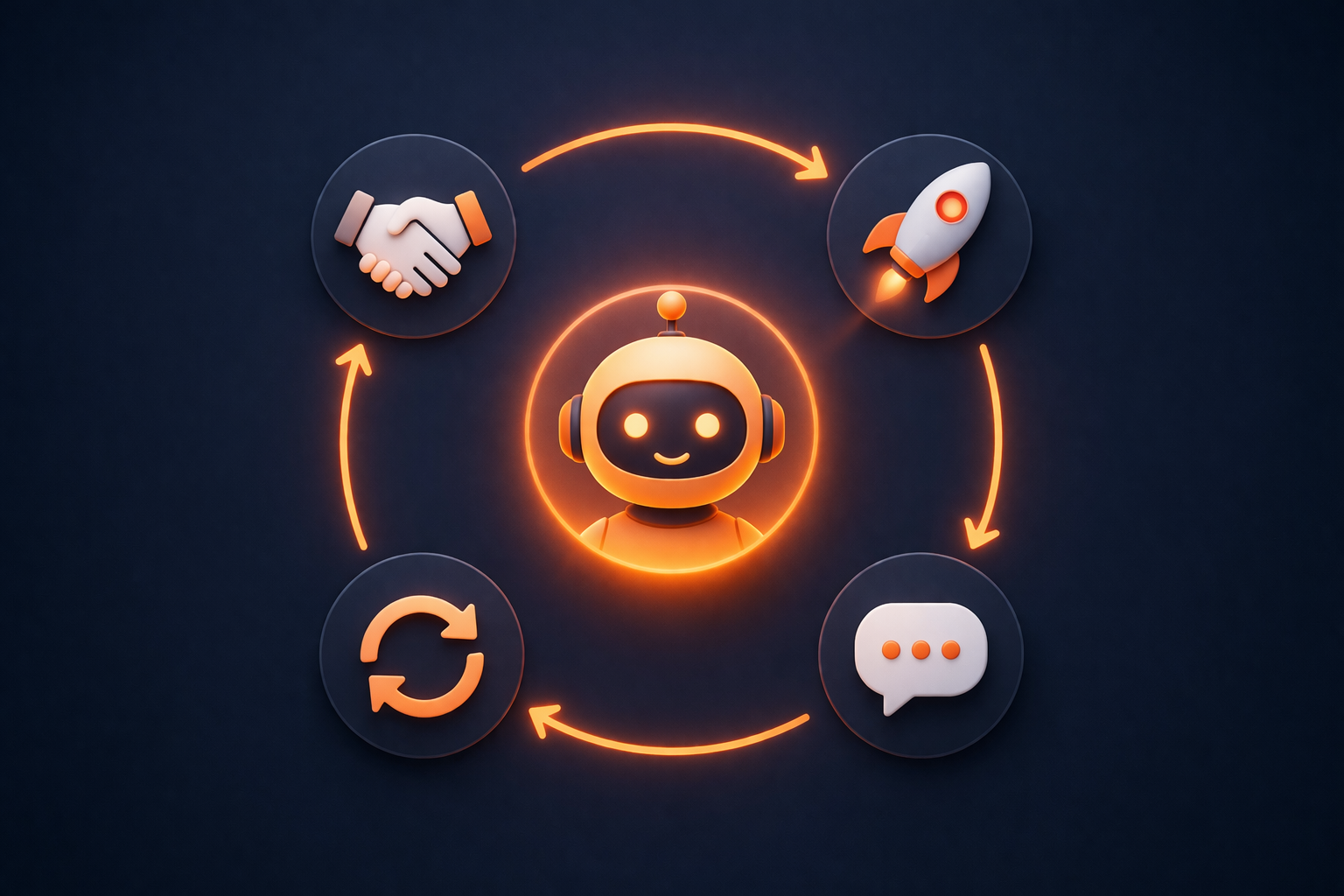
One AI Agent Across Your Entire Customer Lifecycle - Sales, Onboarding, Support, Renewal
Most companies have separate teams for every stage of the customer lifecycle. SDRs for prospecting. AEs for demos. CSMs for onboarding. Support reps for issues. Account managers for renewals.
Each team uses different tools, has different context, and the customer has to re-explain themselves at every handoff. It is a broken experience for the customer and an expensive one for the company.
What if a single AI agent could handle all of it?
Not a chatbot that gives canned responses. A real AI agent that knows your product deeply, understands the customer's history, and can show, explain, and guide across every touchpoint, over live video and voice.
This is not science fiction. We are building towards it at Kickker AI, and the early pieces are already working.
The Handoff Problem
Let me describe what a typical customer journey looks like today:
Sales: Prospect talks to an SDR who qualifies them. Then they talk to an AE who demos the product. The AE takes notes in the CRM.
Onboarding: A CSM picks up the account. They read the CRM notes (maybe) and schedule an onboarding call. The customer explains their use case again. The CSM walks them through setup.
Support: Customer hits an issue 3 months later. They submit a ticket. A support rep who has never spoken to them asks for context. The customer explains everything from scratch.
Renewal: 11 months in, an account manager reaches out. They review usage data and CRM notes to prepare. The customer has to explain what they value and what they want improved.
Every single transition involves context loss. The customer repeats themselves. The new team member scrambles to get up to speed. Stuff falls through the cracks.
The Single Agent Vision
Now imagine this instead:
Sales: A visitor lands on your website. An AI agent greets them, asks what they are looking for, and walks them through the product live. The agent demos relevant features, answers technical questions, and qualifies the lead. Everything is recorded and contextualized.
Onboarding: Same agent (or one that shares the same memory) picks up after the deal closes. It already knows what the customer cared about during the demo. It guides them through setup, focusing on the features they expressed interest in. No re-explanation needed.
Support: Customer hits a snag. They start a session with the agent, which already knows their configuration, their use case, and their history. It navigates to the relevant screen, identifies the issue, and walks them through the fix visually.
Renewal: The agent proactively reaches out before renewal. It knows usage patterns, which features the customer uses most, and what issues they have had. It can present a personalized case for renewal and walk through new features that are relevant to their use case.
One agent. Full context. Zero handoff friction.
Why This is Technically Possible Now
Three things have converged to make this viable:
1. LLMs with sufficient reasoning. Modern language models can understand complex product documentation, customer context, and conversational nuance well enough to hold meaningful, multi-turn conversations about your product.
2. Browser automation maturity. We can now build agents that reliably navigate live web applications, click buttons, fill forms, and demonstrate features in real time. This was not reliable even 18 months ago.
3. Cross-session memory. The ability to persist context across interactions means an agent that talked to a customer during a demo can recall that conversation during onboarding, support, or renewal.
At Kickker AI, our architecture is built around this. We have a central knowledge ingestion layer (product docs, support tickets, sales call transcripts, FAQs), an execution engine for browser automation, and a quality evaluation model that ensures the agent stays accurate and on-brand.
Where We Are Today
Let me be honest about where things stand. We are not at the full lifecycle vision yet. Nobody is. But the building blocks are in place and the early use cases are working.
Today, our agents handle:
In the next 6-12 months, we are expanding to:
The longer-term vision includes agent-to-agent interactions. Where a buyer's AI agent talks to a seller's AI agent to evaluate products, negotiate, and close deals. That sounds futuristic, but the APIs and protocols are being built right now.
What This Means for Your Team
This does not mean firing your sales and support teams. It means fundamentally changing what they spend their time on.
Instead of SDRs doing first calls with every lead, they focus on high-value accounts that need a human touch. Instead of CSMs doing the same onboarding walkthrough 20 times a month, they focus on strategic accounts and edge cases. Instead of support reps answering the same 50 questions daily, they handle genuinely complex issues.
The AI agent handles the repeatable, scalable interactions. Humans handle the exceptions, the relationship building, and the strategic work.
The Economics
This is where it gets compelling. Consider a company with:
That is $870K/year in salary alone, before tools, benefits, and overhead.
A single AI agent platform that handles 60-70% of the repeatable interactions across all three functions could reduce this to 2 SDRs, 2 CSMs, and 2 support reps, with better coverage (24/7), faster response times, and more consistent quality.
I am not saying this happens overnight. But the trajectory is clear.
Getting Started
You do not have to go all-in on the full lifecycle vision on day one. Start where the pain is highest:
If you are losing website visitors: Start with an AI agent for product demos and lead capture. This is where we see the fastest ROI.
If onboarding is slow: Deploy an agent that guides new users through setup and answers their questions visually.
If support is overwhelmed: Start with visual support guides that show users how to fix common issues.
Each deployment builds the knowledge base and interaction data that makes the next one better. The flywheel compounds.
The Bottom Line
The customer lifecycle is fragmented because we built separate tools and teams for each stage. AI agents offer a path to unify it. Same context, same knowledge, same experience from first visit to renewal.
We are early in this journey, but the companies that start building towards it now will have a massive advantage in 2-3 years. The technology is ready. The question is who moves first.
Want to see Kickker AI in action? Get in touch