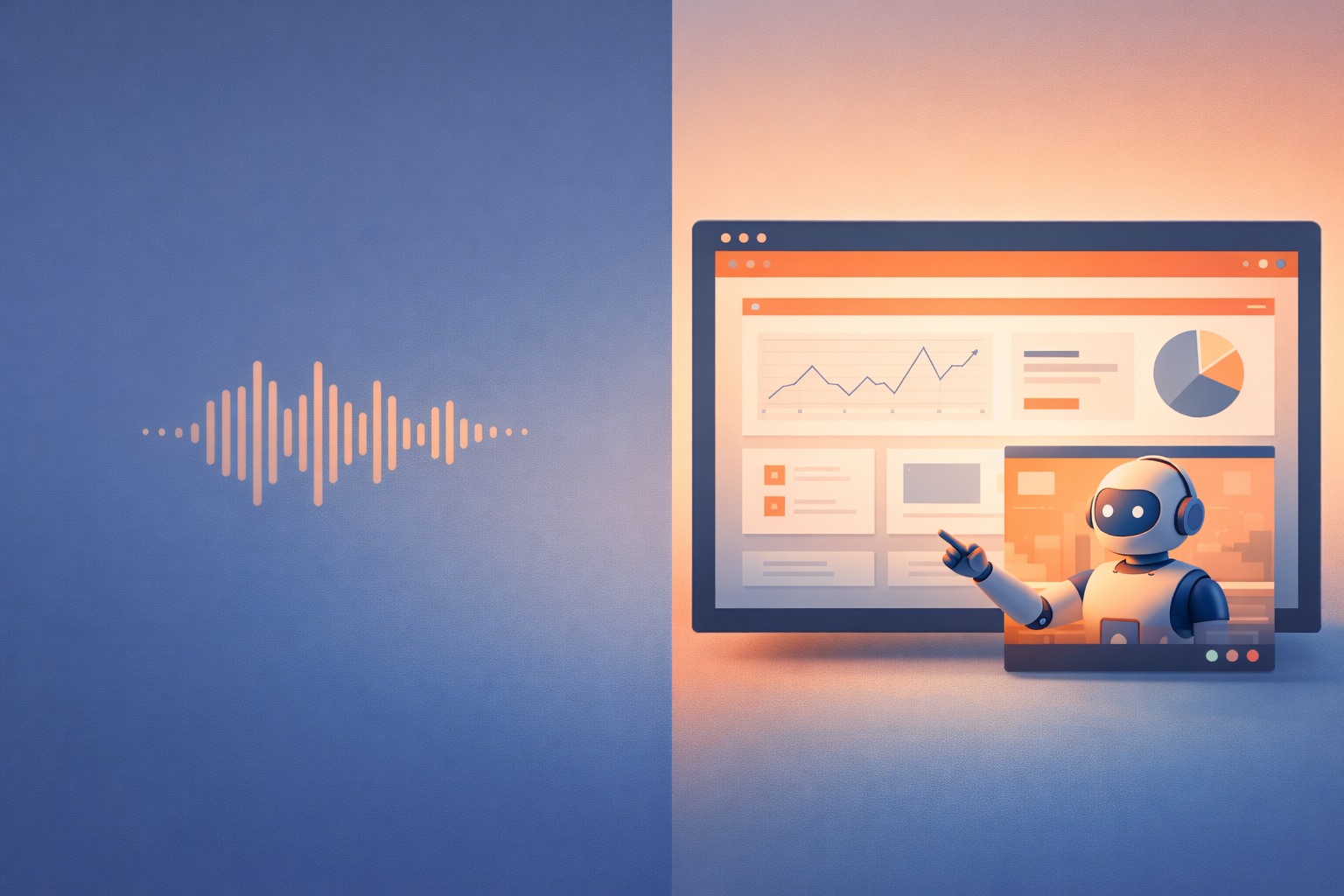
Video AI Agents vs. Voice Agents - Why Talking Isn't Enough
There are hundreds of voice AI agents on the market right now. Vapi, Bland, Retell, and dozens more. They are getting really good at having natural phone conversations, qualifying leads, booking meetings.
But here is the thing. If you are selling a software product, talking about it is fundamentally different from showing it.
I have spent the last 11+ years building production AI systems at Google, Microsoft, Amazon, and Booking.com. And the one thing I have learned is that the interface matters as much as the intelligence. How you deliver information changes what people do with it.
Voice agents talk. Video AI agents show. That distinction matters more than most people realize.
The Problem With Voice-Only
Picture this. A prospect calls your voice AI agent and asks: "Can you show me how your analytics dashboard works?"
The voice agent says: "Sure! Our analytics dashboard has real-time data visualization, custom filters, export capabilities, and team-level permission controls."
That is accurate. But it is useless. The prospect wanted to see it. They wanted to watch someone navigate the dashboard, click through filters, and understand the layout. They wanted a visual experience.
Now imagine the same question with a video AI agent. The agent shares its screen, opens the dashboard, walks through each section, applies a filter live, and exports a sample report. All while explaining what it is doing in a natural, conversational voice.
Same question. Completely different experience. Completely different conversion outcome.
Why This Matters for B2B SaaS
B2B software products are visual by nature. They have dashboards, workflows, forms, settings, and integrations. Describing these things verbally is like describing a painting over the phone. You can do it, but you lose 90% of the information.
Here is where voice agents work well:
Here is where they fall short:
If your customer-facing workflows require screen sharing, live interactions, or visual context, voice alone is not enough.
The Technical Gap
Building a voice AI agent and building a video AI agent are fundamentally different engineering challenges.
A voice agent needs:
A video AI agent needs all of that plus:
The second list is significantly harder. You need the agent to understand the browser state, know which element to click, when to scroll, when to wait for a page to load, and do all of this while maintaining a natural conversation.
This is why there are hundreds of voice agent companies and very few doing what we are doing at Kickker AI. The engineering complexity is an order of magnitude higher.
Real-World Example
One of our early customers is an ed-tech company. They were using a chatbot on their website to answer visitor questions. It handled maybe 40% of queries well. The rest were about product-specific features that required visual explanation.
When we deployed a Kickker AI agent, visitors could ask "Show me how the student progress tracking works" and the agent would actually open the dashboard, navigate to the tracking module, and walk through a sample student profile, live. The visitor could ask follow-up questions while watching.
The result: engagement time went from under 1 minute to over 4 minutes, and they started capturing leads that were previously bouncing.
Voice and Video Are Not Competing
I want to be clear. This is not a "voice is bad" argument. Voice AI agents are great for specific use cases. If you are running an outbound calling operation or handling inbound phone queries, voice agents are the right tool.
But if your product is software, and your customer needs to see it to understand it, then voice alone leaves a huge gap. You need something that can show, not just tell.
The future is probably multi-modal. Agents that can talk, show, navigate, and interact, all at the same time. That is what we are building at Kickker AI.
The Convergence is Coming
Right now, the market has:
Nobody was combining all three into a single, real-time customer-facing experience. That is the whitespace we are building in.
An AI agent that talks to your customer naturally, navigates your product live, answers their questions contextually, and does it all over a video call. That is not incremental improvement. That is a fundamentally new category.
What This Means For You
If you are evaluating AI agents for your sales or customer experience stack, ask yourself:
1. Does my product require visual explanation? If yes, voice alone will not cut it. 2. Are my prospects asking to "see" the product? If yes, you need something that can show them. 3. Are my best demos the ones where someone shares their screen? If yes, that is the experience you need to replicate with AI.
The companies that figure this out early will have a significant advantage. Because while everyone else is talking about their product, you will be showing it.
Want to see Kickker AI in action? Get in touch